What is email list decay?
Email list decay is the gradual degradation of your list's quality as addresses become invalid, disengaged, or unreachable over time. It happens continuously — even when you're not actively sending — because the world your list was built from keeps changing.
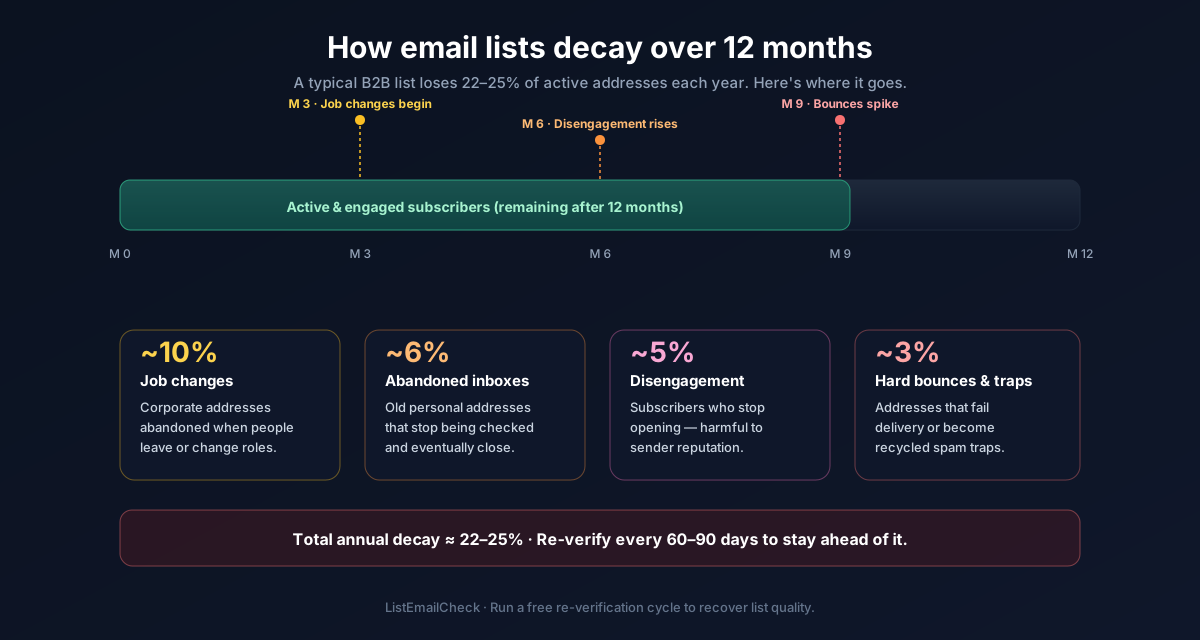
The generally accepted decay rate for email lists is 22–25% per year. That means a 10,000-person list that's left alone for 12 months will have roughly 2,200–2,500 addresses that are no longer deliverable or engaged by the end of the year.
Once decay starts showing up, the next steps are usually a cleanup and a reactivation pass. For that workflow, see the re-engagement email campaign guide and how to clean your email list for free.
What causes list decay?
- Job changes (B2B) — when someone leaves a company, their business email is deactivated. In high-turnover industries, this can happen within days of departure.
- Abandoned personal email accounts — people create new Gmail or Outlook accounts and stop checking old ones. The old address may still accept email (going to a never-checked inbox) or eventually expire and bounce.
- ISP domain closures — smaller or regional ISPs occasionally shut down, invalidating all addresses on their domain.
- Deliberate disengagement — subscribers who stay on your list but stop opening are "functionally decayed" — their presence harms your engagement metrics and deliverability even if the address still works.
How to measure your current decay rate
The simplest measurement: take the hard bounce rate from your last campaign and multiply by 12 (if sending monthly) to estimate annual decay. A 1.5% bounce rate per send equals roughly 18% annual decay in that segment.
For a more precise measurement, re-verify a list segment that hasn't been mailed in exactly 90 days using ListEmailCheck and compare the invalid count to the original clean baseline. This gives you a real 90-day decay figure for your specific audience.
5 strategies to slow email list decay
1. Send consistently (the most underrated fix)
Frequent sending surfaces decayed addresses quickly — they bounce immediately, giving you accurate, up-to-date data. Infrequent senders accumulate decay silently, then get hit with a large spike of bounces when they finally send to a long-dormant list.
For B2B lists especially, a minimum of monthly sends keeps your bounce data current and your list quality measurable.
2. Verify before every send to dormant segments
Any segment that hasn't been mailed in 60+ days should be re-verified before reactivation. Run it through ListEmailCheck's bulk verifier to identify addresses that have decayed since your last send.
3. Use welcome emails as early decay detection
A transactional welcome email sent immediately upon signup is an early indicator of list quality. If it hard bounces, that address was invalid at signup — remove it immediately before it becomes a persistent bad record.
4. Run regular re-engagement campaigns
Subscribers who haven't engaged in 90–180 days are exhibiting "behavioural decay" — they're still reachable but no longer interested. A structured re-engagement campaign either wins them back or gives you permission to suppress them. Both outcomes stop the decay from damaging your metrics.
5. Implement a sunset policy
A sunset policy is a predetermined rule: after X months of zero engagement, a subscriber is automatically suppressed from future sends. A common benchmark is 6 months for consumer lists and 3 months for B2B. This keeps your active list lean and your engagement metrics accurate.
The compound effect of ignoring list decay
The danger of letting decay accumulate is not just higher bounce rates on the next send. It's a downward spiral:
- High bounce rate → lower sender reputation
- Lower reputation → more emails routed to spam
- More spam routing → lower open rates (even for your engaged subscribers)
- Lower open rates → inbox providers further deprioritise your emails
Regular hygiene breaks this cycle before it starts.
Key takeaways
- Email lists decay at roughly 22–25% per year — even without any change on your end
- B2B lists decay faster than consumer lists due to employee churn
- Consistent sending surfaces decay quickly; infrequent sending lets it accumulate silently
- Re-verify any segment dormant for 60+ days before sending
- Implement a sunset policy — suppress anyone with zero engagement after 3–6 months
- Run your list through ListEmailCheck to measure and remove decayed addresses — free up to 1,000/day.