Why email bounce rate benchmarks matter
Your bounce rate is one of the most direct signals inbox providers use to assess your sending reputation. A bounce rate above the acceptable threshold — even for a single campaign — can trigger spam filtering, throttling, or account suspension by your email service provider.
Understanding what "acceptable" looks like in your context is the first step to keeping your sending infrastructure healthy.
Before comparing your numbers, review how to remove hard bounces from your email list and what email deliverability is so you know which failures are damaging and which metrics matter most.
Hard bounce vs. soft bounce: a quick recap
- Hard bounce — permanent delivery failure. The address doesn't exist, the domain is invalid, or the recipient's server has permanently blocked your messages. Hard-bounced addresses must be removed immediately and never mailed again.
- Soft bounce — temporary delivery failure. The inbox is full, the recipient's server was temporarily unavailable, or your message was too large. Most email platforms retry soft bounces automatically for 24–72 hours.
When people talk about "bounce rate benchmarks," they are almost always referring to hard bounce rate. Soft bounces are generally not penalised in the same way.
Email bounce rate benchmarks in 2026
General acceptable thresholds
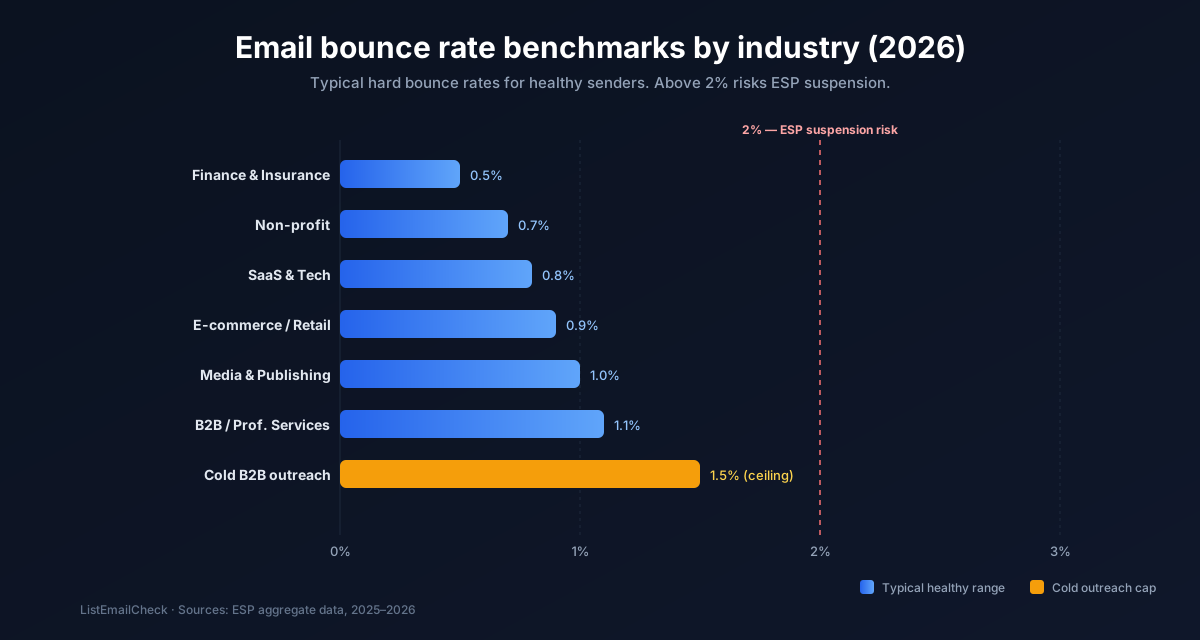
- Under 0.5% — excellent. This is the benchmark for well-maintained lists with regular sending cadence and proper list hygiene.
- 0.5% – 1% — acceptable, but should prompt a review of your list hygiene practices and acquisition sources.
- 1% – 2% — high risk. Most ESPs will flag your account for review. Immediate list cleaning is required.
- Above 2% — critical. Google and Yahoo's 2024 bulk sender guidelines specifically cite 0.3% as the threshold above which they will begin taking action on your sending domain. Sustained rates above 2% frequently result in account suspension.
By email type
| Email Type | Acceptable Hard Bounce Rate |
|---|---|
| Transactional (receipts, resets, alerts) | < 0.5% |
| Newsletter / marketing | < 0.5% |
| Cold outreach (first send) | < 3% (after list verification) |
| Re-engagement campaigns | < 1% (after segment verification) |
| Event / webinar invites | < 0.5% |
Cold outreach from an unverified list routinely exceeds 5–10% bounce rates, which is why verification before sending is a non-negotiable step for anyone doing outbound email.
By industry (2026 averages)
- E-commerce: 0.2% – 0.5%
- SaaS / technology: 0.3% – 0.7%
- B2B services / consulting: 0.4% – 1.0%
- Agencies: 0.5% – 1.2%
- Non-profit / education: 0.3% – 0.6%
B2B lists typically see higher bounce rates than consumer lists because business email addresses churn faster — employees leave, companies rebrand, and mail servers change.
What causes high bounce rates?
- Old or purchased lists — lists that haven't been used or cleaned in 6+ months accumulate a significant percentage of invalid addresses.
- No double opt-in — single opt-in allows users to submit typos or fake addresses at signup, which pass unnoticed until you send.
- No verification before sending — especially for cold outreach or freshly imported CRM data.
- Infrequent sending — lists that are only emailed quarterly or annually have high address churn because invalids are never identified and removed.
- Missing SPF / DKIM / DMARC — while this doesn't cause hard bounces directly, poor authentication causes more emails to be rejected, raising effective bounce rates in your platform's reporting.
How to keep your bounce rate under 0.5%
- Verify before every send — run your list through ListEmailCheck before importing to your ESP. Remove invalid and high-risk addresses.
- Use double opt-in for new subscribers — confirmed opt-in eliminates typos and fake addresses at the source.
- Send regularly — frequent sending surfaces bounces quickly and keeps your list fresh. Irregular senders accumulate more invalids between campaigns.
- Suppress hard bounces globally and immediately — after every send, add all hard-bounced addresses to a suppression list across all your campaigns and domains.
- Re-verify inactive segments before reactivation — segments that haven't been mailed in 90+ days should be verified before a re-engagement campaign.
Key takeaways
- Keep hard bounce rate under 0.5% — above 1% risks ESP flags, above 2% risks suspension
- Google and Yahoo flag senders whose spam complaint rates exceed 0.3% — treat bounce thresholds as equally important
- Cold outreach requires list verification before every send to stay within acceptable bounds
- B2B lists have higher natural churn — verify more frequently than consumer lists
- Hard bounces must be suppressed globally and immediately after every campaign
- Verify your list with ListEmailCheck before your next send — free up to 1,000 addresses/day, no credit card required.